

Contents
Table of Contents
Influencer pricing feels random because, honestly, it is messy in most inboxes. One creator quotes €150 for a Reel, another asks €1,500 for something that looks similar, and neither of them is necessarily “wrong.” A lot of rates aren’t built on a consistent logic, they’re built on what that creator charged last time, what their friends told them to charge, or what a brand paid them once and they never updated. On the brand side, it gets even more confusing because you’re comparing completely different deliverables (a Story set vs a Reel vs a TikTok), different levels of effort, and different expectations around usage rights… but everyone just calls it “a collab.”
The bigger issue is that the old shortcut, “followers = price”, doesn’t really hold up anymore. Two creators can both have 50k followers and perform totally differently. One has an audience that actually clicks and buys. The other has views but no conversion. Some creators are incredible on camera and can sell. Others look great in-feed but can’t hold attention in a 20-second video. Add in niche (beauty vs finance vs fitness), platform differences, and whether a brand wants to run the content as paid ads, and suddenly follower count becomes a weak way to predict value.
This guide is here to make it simpler, without pretending it’s one fixed number. You’ll get practical pricing ranges by deliverable, plus the key “pricing levers” that change rates fast (platform, complexity, niche, usage rights, whitelisting). More importantly, you’ll get a clean way to budget that doesn’t rely on guesswork, so you can test creators, learn what works, and scale the ones that actually perform, without feeling like you’re gambling every time you send an offer.
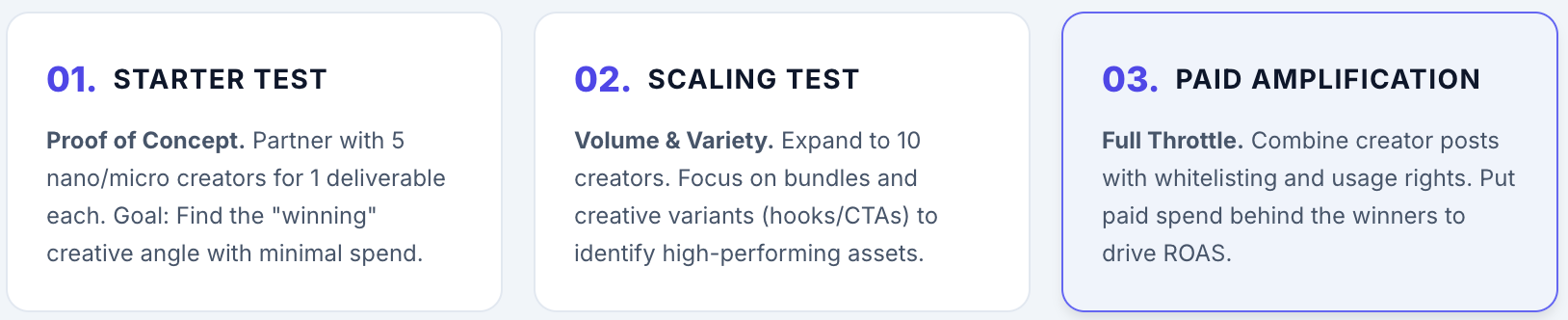
And if you want to skip the back-and-forth and the awkward “so what’s your rate?” dance, run your first shortlist and send offers inside Social Cat, it’s a faster way to compare creators, set clear deliverables, and start with a small paid test instead of overcommitting upfront.
What You’re Actually Paying For
When a brand pays an influencer, it feels like you’re paying for “a post.” But that’s not really what you’re buying. You’re buying three different things bundled together — and most pricing fights happen because one side is talking about Bucket #1 while the other side is thinking Bucket #3.

1) The post (distribution + trust)
This is the influencer’s audience and the relationship they’ve built with it. You’re paying for reach, yes, but more importantly you’re paying for attention in context. When someone posts on their own account, they’re effectively lending you their credibility for a moment. That’s why two creators can have the same follower count and completely different rates, one might have an audience that actually listens and takes action, while the other has an audience that scrolls.
This bucket is also where niche and “fit” matter. A creator with a smaller but highly aligned audience can be more valuable than a bigger creator whose audience doesn’t care about your category.
2) The content (effort / production)
Separate from distribution is the actual work. Filming, scripting, editing, revisions, lighting, props, setting, time spent understanding the product, and the admin that happens before anything goes live. Some creators can produce a clean, convincing Reel in 45 minutes because they’ve done it 200 times. Others need half a day. Some deliver one straightforward video. Others deliver a full “mini ad” with multiple scenes, captions, b-roll, and variations.
This is why “one Reel” isn’t one Reel. The difference between a basic lifestyle clip and a structured, direct-response style video is often the difference between “nice content” and “content that sells.” The production expectations change the price.
3) The rights (what the brand can do with it)
This is the part that gets skipped the most, and causes the most drama later.
Usage rights determine whether you’re only allowed to use the content once, on the influencer’s own channel, or whether you can also reuse it on your brand channels, website, email, product pages, landing pages, and (most importantly) paid ads. The more usage you want, the more value you’re extracting from that content, and the more the creator should be compensated.
It also includes things like duration (30 days vs 12 months), territory (one country vs worldwide), exclusivity (they can’t work with competitors), and whitelisting (running ads through the creator’s handle). These aren’t “small add-ons.” They change what you’re buying.
Social Cat angle: why pricing feels chaotic
Most influencer pricing confusion comes from brands and creators not defining these three buckets upfront. A creator might quote a price thinking it’s for a single organic post. A brand reads it and assumes they can reuse the content everywhere and run it as ads. Or the brand thinks they’re paying mainly for reach, while the creator is pricing in heavy production and revisions. Same word (“collab”), totally different deal.
The fix is boring but powerful: clarify post vs content vs rights before money is discussed.
5 Pricing “Levers” That Change Rates Fast
Influencer rates aren’t random, they just move fast when a few variables change. If you understand the levers below, you’ll instantly see why one creator says “€150” and another says “€1,500” for something that sounds similar on paper.
1) Platform (IG / TikTok / YouTube)
Each platform has a different “value” for brands because the content behaves differently.
On Instagram, Stories are great for quick bursts (links, promo codes, urgency), while Reels can live longer and get discovery, but creators often price Reels higher because they require more effort and affect their feed.
On TikTok, creators usually think in “video-first” terms, and brands often want multiple attempts (hooks/angles). TikTok can also deliver outsized results for the right product, so creators who know their content converts will price with confidence.
On YouTube, long-form is typically the highest commitment and often the highest price because it’s more time, more trust, and more permanent. Shorts can be closer to TikTok/IG Reels in pricing, but the “channel value” can still push rates up.
2) Deliverable type (Story set vs Reel vs dedicated video)
Not all posts are equal, even inside the same platform.
A Story set (for example 3–5 frames) is usually quicker to produce, less edited, and disappears fast, so it’s often priced lower than a dedicated feed video.
A Reel / TikTok video is a heavier deliverable: filming, editing, pacing, captions, sometimes voiceover, sometimes multiple takes. It also sits on the creator’s profile, so they’re more careful about what they publish, that “risk” is part of the price.
A dedicated video (where the entire piece is about you, not a casual mention) is usually the highest rate within short-form because the creator is putting your product front and center. You’re buying more attention and more brand association.
3) Creator tier (nano → macro) + niche demand
Follower count alone is outdated, but tier still matters because it correlates with demand and negotiating power.
Nano and micro creators often have more flexible pricing, but niche fit can raise rates quickly. A nano creator in a high-intent niche (skincare routines, fitness, parenting, B2B tools) may price higher than a larger general lifestyle creator because their audience buys.
Macro creators don’t just sell reach, they sell distribution at scale, consistency, and often a proven track record. Many also have management, higher opportunity cost, and stricter requirements, which pushes rates up.
The real multiplier here is niche demand. If a creator sits in a niche where brands are actively spending (beauty, wellness, finance, fashion, apps), they can charge more regardless of follower count.
4) Usage rights + whitelisting
This is the lever that brands underestimate the most.
If you’re only paying for an organic post, the brand’s benefit ends when the content has finished its natural life. But if you want to reuse it on your site, in emails, on ads, in retargeting, you’re extracting more value from the same asset.
Whitelisting (running ads through the creator’s handle) is another jump because it ties the creator’s identity to paid distribution. It can impact how their audience perceives them, and it can create “wear-out” in their feed. It’s normal for creators to charge a clear add-on for this, sometimes a flat fee, sometimes monthly.
If you want consistent, scalable budgeting, treat rights and whitelisting as line items, not awkward surprises after the quote.
5) Turnaround speed + complexity
Speed and complexity quietly double budgets.
A creator delivering “next week” is one thing. Delivering in 48 hours is another. Fast turnaround compresses their schedule and often pushes out other work, that’s why rush fees exist.
Complexity includes things like multiple scenes, specific locations, extra people, scripts that must be followed exactly, multiple rounds of revisions, heavy on-screen text, or very “ad-like” structure. The more the deliverable starts to feel like production, the less “simple collab” pricing applies.
Social Cat angle: standardize the levers so quotes stop being chaotic
These levers can be standardized inside your campaign brief so creators quote consistently.
When the brief clearly defines platform, deliverable type, tier expectations, rights/whitelisting needs, and turnaround/complexity, creators don’t have to guess, and you don’t get random pricing based on assumptions. It turns “pricing vibes” into a clear scope, which is exactly how you avoid getting burned (or accidentally underpaying and getting low effort).
In 2026, influencer pricing still feels random because most brands and creators aren’t pricing the same thing.
One creator quotes for “a Reel” like it’s just a post. Another creator includes filming, revisions, and paid usage. Another adds whitelisting. And suddenly the range looks insane, even though the deliverable name is the same.
That’s why “followers = price” is outdated. Two creators can have the same follower count and completely different value depending on niche demand, trust, consistency, and how much work the deliverable actually requires.
So instead of pretending there’s one universal rate card, here are realistic ranges you can budget with — with one important twist: for nano and micro, the baseline is often gifted-first (creator fee = €0) as long as the request stays simple and organic.
2026 pricing ranges (gifted-first for nano + micro)
For nano + micro, it’s common to run collaborations at €0 creator fee (gifted), especially when the brand is testing creators, building volume, or targeting niche communities. This works best when the deliverable is straightforward, the brief is clear, and there’s no paid usage attached.
For mid-tier and macro, you’re usually paying for distribution, trust, and predictable performance, so you’ll see paid rates much more consistently.
Use the ranges below as a budget guardrail, not a rule.
A story set (3–5 frames) is one of the easiest asks for creators, so it’s often the best entry point for gifted-first testing.
Typical ranges:
- Nano: €0 (gifted)
- Micro: €0 (gifted)
- Mid-tier: €150–€800
- Macro: €800–€4,000+
A dedicated Reel (15–45s) is more effort and more brand risk (it stays on the grid), so rates climb.
Typical ranges:
- Nano: €0 (gifted)
- Micro: €0 (gifted)
- Mid-tier: €300–€1,500
- Macro: €2,000–€10,000+
A carousel (5–10 slides) sits in the middle: easier than video, but still production + thoughtful structure.
Typical ranges:
- Nano: €0 (gifted)
- Micro: €0 (gifted)
- Mid-tier: €200–€1,000
- Macro: €1,500–€8,000+
If you want efficiency, a Reel + stories bundle (1 Reel + 3–5 story frames) is a strong “one brief, multiple placements” option.
Typical ranges:
- Nano: €0 (gifted)
- Micro: €0 (gifted)
- Mid-tier: €500–€2,500
- Macro: €3,000–€15,000+
TikTok
A single TikTok (15–45s) is usually priced similarly to Reels at the paid tiers, but gifted-first is still very normal for nano/micro.
Typical ranges:
- Nano: €0 (gifted)
- Micro: €0 (gifted)
- Mid-tier: €300–€2,000
- Macro: €2,500–€15,000+
A 2–3 TikTok bundle is where brands get better testing value, especially if each video uses a different hook/angle.
Typical ranges:
- Nano: €0 (gifted)
- Micro: €0 (gifted)
- Mid-tier: €700–€4,000
- Macro: €5,000–€25,000+
YouTube
A YouTube integration (60–120s inside a long-form video) is a bigger commitment and usually lands in paid territory faster once creators have consistent views. That said, gifted-first still happens at the smaller tiers when brands are testing.
Typical ranges:
- Small channel / nano: €0 (gifted)
- Micro: €0 (gifted)
- Mid-tier: €800–€5,000
- Macro: €7,000–€40,000+
A Shorts add-on is often an easy extra placement and can work well as a bonus in bundles.
Typical ranges:
- Nano: €0 (gifted)
- Micro: €0 (gifted)
- Mid-tier: €200–€1,200
- Macro: €1,500–€8,000+
The gifted-first boundary (so “free” doesn’t turn into chaos)
If you’re using gifted collaborations for nano and micro, you need one line in your process that protects you:
Gifted-first usually means organic use only, light revisions, and a reasonable scope. The moment you add paid usage, whitelisting, long usage duration, heavy scripting, or multiple rounds of revisions, it stops being “free” — and it becomes a paid deal.
That’s how you keep the model fair for creators, while still making nano/micro accessible for brands.
Benchmarks help you avoid extremes, but the real win is matching the right creator to the right ask — that’s where campaigns usually fail. Most pricing confusion happens because brands don’t define the deliverable, the effort, and the rights upfront.
On Social Cat, this is exactly what your campaign flow can force: clear deliverables, clear usage terms, and clear expectations — so creators quote consistently and you don’t get surprised halfway through.
Usage Rights: The Part That Quietly Doubles Your Cost
This is the part most brands “forget” to define… and then wonder why a creator suddenly raises the price.
Because once you move past organic posting, you’re no longer paying just for content and distribution. You’re paying for permission — what your brand is allowed to do with that content, for how long, and where.
And yes: usage rights can easily double (or more) your total cost if you don’t lock them early.
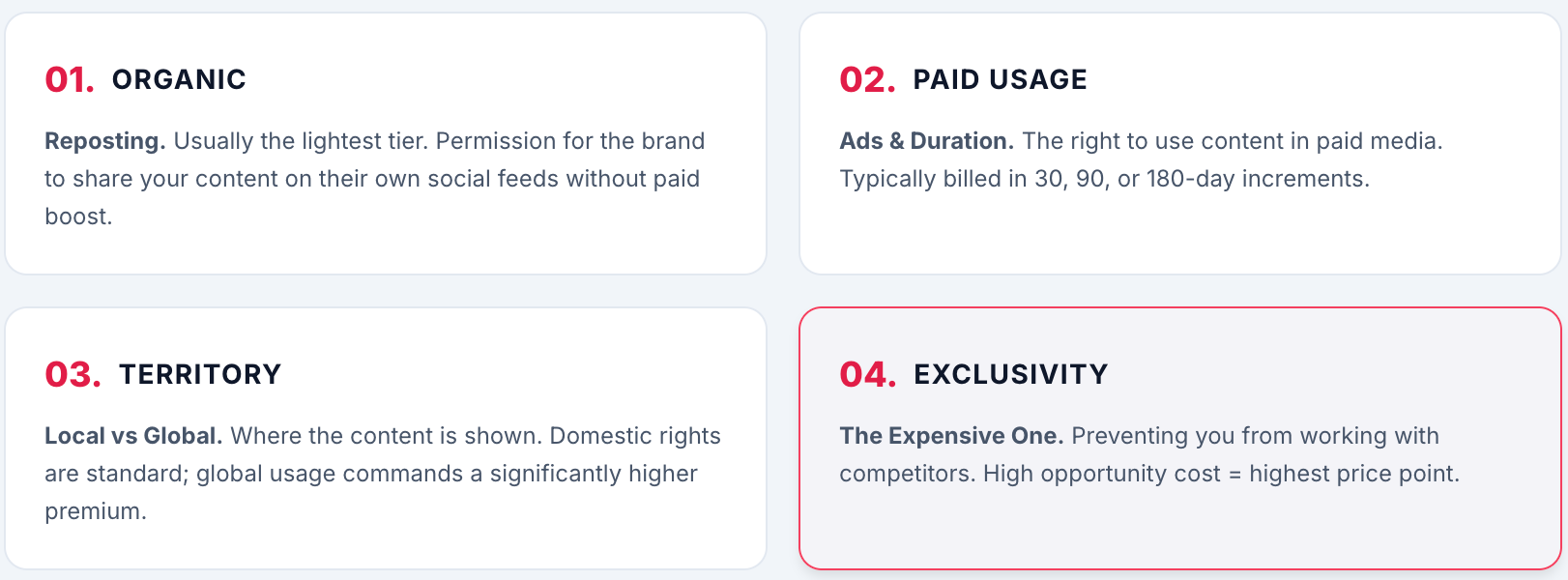
Organic reposting (usually lighter)
Organic usage is the simplest version. Think: the creator posts on their channel, and you repost it on your brand’s socials (IG, TikTok, Pinterest, website feed).
This is usually priced “lighter” because you’re not turning the creator into an ad asset. You’re just using the content as social proof and content filler.
Still, don’t assume it’s automatic. Some creators allow reposting by default, others want it listed explicitly. Either way, write it down.
Paid usage (ads) + duration (30 / 90 / 180 days)
The moment you want to run the content as an ad, it’s a different deal.
Paid usage means the brand can use the creator’s video/image in paid placements: Meta ads, TikTok ads, YouTube ads, Spark Ads, etc.
Duration is where the cost escalates fast:
- 30 days is typically the “starter” paid usage window
- 90 days is common for real testing + scaling
- 180 days starts leaning into “you’re buying a long-term asset” territory
The simple rule: more time = more value extracted = higher price.
If you’re budgeting, don’t treat paid usage like a tiny add-on. For many creators, it’s the main reason they charge more.
Territory (local vs global)
Territory sounds boring, but it matters.
Local territory means you’re using the content in one market (for example: Romania only, UK only, US only). Global means you can run it anywhere.
Global usage usually costs more because the creator’s face and voice are being used to sell worldwide, which is a bigger commercial use of their likeness.
Exclusivity (the expensive one)
Exclusivity is the one that brands accidentally ask for without realizing what they’re doing.
Exclusivity means the creator can’t work with competitors for a period of time (or sometimes can’t even mention them). That can block income for the creator, which is why it’s priced high.
If you want exclusivity, define it clearly:
- category (what counts as a competitor?)
- duration (30/60/90 days?)
- scope (only paid ads? any content? any platform?)
If it’s vague, it becomes a negotiation mess. If it’s clear, creators can price it properly and you avoid surprises.
The rights rule that saves you headaches
If you don’t define rights upfront, you will either:
- overpay because you’re negotiating late, or
- underpay and end up with creators upset (or refusing usage), or
- run content without permission and create legal risk.
That’s why this shouldn’t be a “later” conversation.
Social Cat angle: treat rights like a checklist, not a vibe.
Add a simple “rights checklist” to every campaign and collect it upfront:
- Organic reposting allowed? (yes/no)
- Paid usage allowed? (yes/no)
- Duration: 30 / 90 / 180 days
- Territory: local / global
- Whitelisting: yes/no (and where)
- Exclusivity: yes/no (category + duration)
And always lock it in writing — even if it’s just a clean line in the campaign agreement. Your campaign flow should collect this upfront so creators quote consistently, brands budget correctly, and nobody gets burned later.
Whitelisting Add-Ons: When You Run Ads
From the Creator’s Account
Whitelisting (also called Spark Ads on TikTok or Branded Content Ads on Meta) is when your brand runs paid ads using the creator’s handle — so the ad looks like it’s coming from them, not from your brand page.
It often performs better because it feels more native and carries the creator’s social proof. But it also adds risk and responsibility on the creator’s side, which is why it’s usually priced separately.
What whitelisting actually includes
When a creator agrees to whitelisting, they’re typically allowing some version of:
- their account handle/name to appear on the ad
- the content to be promoted through their identity
- the brand to access/run the ad via a code, partnership permission, or account connection (depending on platform)
This is not the same as “paid usage rights.” Paid usage is permission to run the asset in ads. Whitelisting is permission to run it as the creator.
Why it costs more
Creators charge more for whitelisting because:
- their personal brand is now directly attached to your ad performance
- they may receive comments/DMs because of your campaign
- they’re taking reputational risk if the brand, offer, or messaging is controversial
- some creators have to manage approvals and permissions inside their account settings
Even if it takes them “2 minutes” to share a code, the real cost is not time — it’s identity + risk.
Typical add-ons (how to think about pricing)
Instead of locking one universal price (because creators vary a lot), it’s cleaner to think in tiers:
- Light add-on: whitelisting access for one platform, short duration, limited edits
- Standard add-on: 30–90 days, one platform, includes a couple of variations/cutdowns
- Heavy add-on: multi-platform, longer duration, broader usage, multiple creative versions
The biggest pricing drivers are the same as usage rights:
- duration (30/90/180 days)
- platform (Meta vs TikTok vs both)
- scope (one asset vs a bundle of variants)
- exclusivity / category sensitivity (finance, health, supplements, etc.)
If you want to keep it simple in the article while still being practical, you can frame it like this:
“Expect whitelisting to be priced as an add-on per creator, per platform, per time window — and treat it as a separate line item from the content itself.”
What brands should specify (so creators can quote cleanly)
If a brand says “can we whitelist?” without details, creators either overquote to protect themselves or underquote and regret it.
Always define:
- Platform: Meta / TikTok / both
- Duration: 30 / 90 / 180 days
- Placement scope: just feed? all placements?
- Creative scope: one video or multiple variants?
- Editing rules: can you cut, caption, or change the hook?
- Comment moderation: who handles it if the ad gets messy?
Social Cat angle: make whitelisting a clean checkbox, not a negotiation
Most “pricing drama” happens because the brief doesn’t define whitelisting clearly, so creators interpret it differently.
Inside a Social Cat campaign flow, whitelisting should be collected like a form:
- Whitelisting requested? yes/no
- Platform(s)
- Duration
- Editing permissions
- Add-on budget range (optional)
That turns “What do you mean by whitelisting?” into “Yes, I can do 90 days on Meta with light editing allowed.”
Way less friction. Way more consistent quotes.
How to Budget Influencer Pricing Without Getting Burned
Here’s the simplest way to stop influencer pricing from feeling like roulette: don’t think in “one price for one post.” Think in a small budget system you can repeat.
A clean influencer budget usually has three lines:
(1) The deliverable fee (the post/content itself)
(2) Rights / paid usage (if you’re running ads or using it beyond reposting)
(3) Optional add-ons (whitelisting, rush turnaround, exclusivity, extra versions)
When brands get burned, it’s almost always because they only budget line #1… and then line #2 and #3 show up later as “surprise costs.”
A practical budget formula you can reuse
Pick your total budget, then split it like this:
- 70–80% for creators + deliverables (the actual content output)
- 10–20% for rights/whitelisting (only if needed)
- 10% buffer for iterations (reshoots, extra cutdowns, small upgrades)
This keeps you safe because you’re assuming there will be tweaks, and you’re not treating rights as an afterthought.
The “small brand” way to do this (without overcommitting)
If you’re testing influencer marketing and you don’t want to waste money, the best approach is a small batch test, not one big creator.
A simple setup looks like:
- A handful of creators (so you get different styles + different audiences)
- One clear deliverable each
- Minimal rights at first (organic usage only), then upgrade the winners
This is where most brands win: you’re not paying premium rights for content you haven’t proven yet.
The “performance brand” way to do this (when you run ads)
If you plan to run paid ads, budget like an ads team:
- You’re not buying “a post.”
- You’re buying creative testing.
That means you should budget for:
- multiple hooks (so you can test angles)
- at least 2 creators (so you’re not stuck with one face/voice)
- paid usage rights for the content you’ll scale
- whitelisting only if you truly need it (it’s powerful, but it’s not mandatory)
A simple rule that prevents 80% of bad deals
Before you approve anything, make sure you can answer this in one sentence:
“What are we buying, where will we use it, and for how long?”
If any of those is unclear, pricing will be messy, expectations will drift, and you’ll end up paying twice (once for the post, once for the fixes).
Social Cat angle: why this gets easier inside your campaign flow
The reason influencer pricing feels chaotic is because brands and creators aren’t quoting the same “thing.” One is thinking organic only, the other is thinking ads. One is thinking one post, the other is thinking variants and whitelisting.
If you structure your campaign brief to collect the essentials upfront, deliverable type, platform, rights, timeline—creators can quote consistently and you can budget cleanly without back-and-forth.
Conclusion
Influencer pricing isn’t random, it only looks random when the brief is vague.
If you separate every deal into three parts, the post (distribution + trust), the content (production effort), and the rights (what the brand can do with it), you’ll stop overpaying, creators will quote more consistently, and you’ll avoid messy “we assumed this was included” surprises.
Benchmarks help you avoid extremes, but the real win is matching the right creator to the right ask with the right rights package. Lock usage and whitelisting in writing upfront, keep exclusivity rare and specific, and start with shorter paid usage windows (then extend only if the content performs).
If you want to skip the guesswork completely, run your shortlist and offer inside Social Cat so every creator responds to the same deliverables + rights checklist from day one.